

dilluns, 11 d’abril del 2011

dilluns, 4 d’abril del 2011


dissabte, 2 d’abril del 2011
Decora (article)
Aquesta tribu urbana va aparèixer a la fi de la dècada dels 90 a Harajuku, una de les zones més popular de Tòquio, on es reuneixen cada diumenge milers d'adolescents amb estètiques molt variades. Decora és un terme japonès procedent de l'anglès decoration (decoració). Les decores tracten de cridar l'atenció amb roba de colors cridaners i emprant el major nombre d'accessoris possible, combinant-los adequadament. Formar part d'aquesta tribu urbana no consisteix, simplement, a posar-se desenes de forquetes i penjolls, sinó que requereix imaginació, mesos de pràctica i paciència. Ser decora és sinònim, per tant, de creativitat.
Aquesta tribu urbana ha evolucionat amb el pas del temps, donant lloc, entre altres, a les anomenades casual decora, caracteritzades per emprar menys accessoris dels utilitzats normalment; a les pink decora, conegudes internacionalment per la seua roba de color rosa, combinada, ocasionalment, amb accessoris de color negre i les dark decora o koteosa, més properes a una estètica gòtica, que s'allunyen de l'estil infantil d'aquesta tribu.
Aquesta tribu urbana ha evolucionat amb el pas del temps, donant lloc, entre altres, a les anomenades casual decora, caracteritzades per emprar menys accessoris dels utilitzats normalment; a les pink decora, conegudes internacionalment per la seua roba de color rosa, combinada, ocasionalment, amb accessoris de color negre i les dark decora o koteosa, més properes a una estètica gòtica, que s'allunyen de l'estil infantil d'aquesta tribu.
dimecres, 23 de març del 2011
The Land of the Rising Sun in shock
This tremor, whose epicentre was 72km east of the Oshika Peninsula of Tohoku, has been named the "Great Eastern Japan Earthquake" by Japanese government. Several fore-shocks were reported before the catastrophe. However, the Japan Meteorological Agency (JMA) did not expect the main earthquake to be so strong. It caused devastating tsunami waves that reached the Pacific coastline of Japan's northern islands and destroyed entire towns such as Kamaishi, Miyako, Ōtsuchi, and Yamada (in Iwate Prefecture), Namie, Sōma and Minamisōma (in Fukushima Prefecture) and Higashimatsushima, Onagawa, Natori, Ishinomaki, and Kesennuma (in Miyagi Prefecture). What is more, Fukushima Dai-ichi nuclear power plant, which is located on Fukushima Prefecture, was damaged by Tohōku tsunami. Due to this fact, radiation levels in Japan are rising and the Japanese government is telling people who live near the Dai-ichi plant to stay indoors and keep their windows close.
More than 17.400 citizens are missing and, unfortunately, around 12.100 deaths have been confirmed by the National Police Agency. In addition, thousands of citizens are affected by the lack of electricity, water and transportation. Most of them have lost everything, all their belongings and their homes, so Red Cross is helping survivors rebuild their lives. A few hours after the earthquake, Google launched a person finder tool, which is available in both Japanese and English. This database, which was used in the Haiti earthquake too, allows Internet users to search for missing people on-line and submit information about their whereabouts. Sadly, some heartless people are writing false information, specially about celebrities.
However, the tremor has not only affected people and structures. Welfare groups are trying to rescue homeless animals. Most of them are in terrible conditions and they have no food. They just wander around destroyed towns during the entire day. Hundreds of animals are dying in agony.
Surprisingly, dogs are sometimes more loyal than people even in time of disaster . For example, a dog refused to leave an injured canine friend in the rubble.
Fortunately, there are also good news. Another dog was found on the roof of a house floating off Kesennuma three weeks after the catastrophe. Finally it was reunited with its owner.
It is obvious that Japan's recovery will be slow and difficult since it has been the strongest earthquake ever recorded in Japanese history. Nevertheless, everybody knows the Japanese are resilient people. They will not give up so easily. They will work extremely hard to overcome the situation. Destroyed structures will turn into new buildings and the Land of the Rising Sun will shine again.
More than 17.400 citizens are missing and, unfortunately, around 12.100 deaths have been confirmed by the National Police Agency. In addition, thousands of citizens are affected by the lack of electricity, water and transportation. Most of them have lost everything, all their belongings and their homes, so Red Cross is helping survivors rebuild their lives. A few hours after the earthquake, Google launched a person finder tool, which is available in both Japanese and English. This database, which was used in the Haiti earthquake too, allows Internet users to search for missing people on-line and submit information about their whereabouts. Sadly, some heartless people are writing false information, specially about celebrities.
However, the tremor has not only affected people and structures. Welfare groups are trying to rescue homeless animals. Most of them are in terrible conditions and they have no food. They just wander around destroyed towns during the entire day. Hundreds of animals are dying in agony.
Surprisingly, dogs are sometimes more loyal than people even in time of disaster . For example, a dog refused to leave an injured canine friend in the rubble.
Fortunately, there are also good news. Another dog was found on the roof of a house floating off Kesennuma three weeks after the catastrophe. Finally it was reunited with its owner.
It is obvious that Japan's recovery will be slow and difficult since it has been the strongest earthquake ever recorded in Japanese history. Nevertheless, everybody knows the Japanese are resilient people. They will not give up so easily. They will work extremely hard to overcome the situation. Destroyed structures will turn into new buildings and the Land of the Rising Sun will shine again.
dilluns, 21 de març del 2011


dimecres, 16 de març del 2011
Tribus urbanes (esborrany)
dilluns, 14 de març del 2011
Tasques
·Guió per a la ràdio amb totes les de tots els grups i corregir l'ortografia. (Fet)
· Article dels hikikomori (Fet)
·Redactar les preguntes per a l'entrevista. (Fet)
·Imatge de les tribus urbanes: escalar, retallar i unir. (Fet)
·Traduir les preguntes de l'entrevista a l'anglès. (Fet)
·Traduir les respostes de l'entrevista a l'anglès. (Fet)
·Publicitat pròpia per a la primera pàgina de la secció Tema Lliure. (Fet)
·Columna d'opinió. (Fet)
·Imatge del Japó. (Fet)
·Buscar informació de les tribus urbanes i escriure l'article. (Fet)
·Article del Japó (Fet)
·Publicitat de l'energia nuclear. (Fet)
· Article dels hikikomori (Fet)
·Redactar les preguntes per a l'entrevista. (Fet)
·Imatge de les tribus urbanes: escalar, retallar i unir. (Fet)
·Traduir les preguntes de l'entrevista a l'anglès. (Fet)
·Traduir les respostes de l'entrevista a l'anglès. (Fet)
·Publicitat pròpia per a la primera pàgina de la secció Tema Lliure. (Fet)
·Columna d'opinió. (Fet)
·Imatge del Japó. (Fet)
·Buscar informació de les tribus urbanes i escriure l'article. (Fet)
·Article del Japó (Fet)
·Publicitat de l'energia nuclear. (Fet)
diumenge, 13 de març del 2011
Entrevista
Our interwevee is Celia Núñez. This girl is sixteen and is from Alicante. She promotes her songs on the Net and she has a lot of fans from different places of Spain.
Interviewer: How did you initiate yourself in music?
Celia: It happened by chance, when I was 7. I had a friend who played the guitar. She encouraged me to go for guitar lessons. Then, I realised music was truly important for me, I could not live without it.
I: Do you play other instruments apart from guitar?
C: Yes, I also play the piano.
I: Which are your musical influences?
C: If I had to mention a specific singer or band, it would be La Oreja de Van Gogh.
I: What are your songs about?
C: They are mostly about love and disappointed in love. I like expressing my feelings and emotions through music. For me, my music is really an expression of who I am, where I have been and a real honest look at my own life.
I: Do you prefer composing your owns songs to covering songs written by others artists?
C: I like doing both.
I: What live performance experience have you had?
C: I performed at school some time ago. I was so embarrassed to sing in public. This year, I am performing again at some pubs.
I: How did you get involved in posting your songs on the Net?
C: I wanted to show my feelings to a boy. We had broken up not too long ago and I wanted him to know how I felt, so I composed a song and uploaded it to Youtube. People liked my voice and I started recording and uploading more covers.
I: Are you open to the idea of collaborating with other singers?
C: Yes, I am. In fact, I have already collaborated with a rapper. It was an interesting experience.
I: Is there anyone in your family who shares your hobby?
C: Yes, a distant cousin. She studied music in conservatory.
I: Does your family support your hobby? What do they think?
C: They agree with it, specially my father. He loves music.
I: Would you like to belong to a band?
C: No, I prefer taking my own decisions and doing things on my own way.
I: What is your opinion about TV musical quiz shows such as Operación Triunfo and The X Factor?
C: They are a swindle. I think judges cannot choose who will succeed or who won't become famous. It makes no sense. People are the real judges.
I: Do you think you may become a successful singer in the future?
C: To be honest, I do not think so. I would be delighted with it. However, it is truly difficult to succeed .
I: Finally, where can our readers listen to you songs?
C: Well, in my public Youtube channel whose name is celcelcelia1 and in my website, www.celianuñez.com
Publicitat pròpia
Tema: la música.
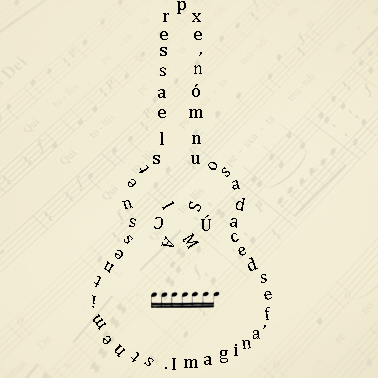
Imagina, fes de cada so un món, expressa els teus sentiments: música.

Imagina, fes de cada so un món, expressa els teus sentiments: música.
dimarts, 8 de març del 2011
Wellcome, Sinde. Goodbye, freedom
One of the strictest anti-downloading laws came into force March 6, 2011 after Spanish parliament passed it. However, this law will not become effective until summer. People who illegally download or upload songs and films will be cut off from the internet . Do we actually need to pass this restrictive law? From my point of view, we do not need it.
Firstly, this law violates a fundamental right in Spain: the freedom of expression. An administrative body chosen by Ministry of Culture cannot pass a law that affect us all without taking into account what citizens think about it. In addition, judges are not involved in the approval process. The validity of Sinde law, therefore, is uncertain.
Secondly, as the Spanish screenwriter and director Álex de la Iglesia said in The Goya Awards ceremony: "The Internet isn't the future; it's the present and the way for hundreds of thousands of people to enjoy movies and culture". Internet is the salvation of our cinema. However, if this law becomes effective, lots of websites will be closed and people will stop watching films or simply listening to music.
In conclusion, thanks to the Internet, people get to know new artists by downloading their songs. Afterwards, they decide if they will buy the CD or not. Logically, they do not want to waste their money. However, Sinde seems to ignore this fact. She is just concerned about money.
Firstly, this law violates a fundamental right in Spain: the freedom of expression. An administrative body chosen by Ministry of Culture cannot pass a law that affect us all without taking into account what citizens think about it. In addition, judges are not involved in the approval process. The validity of Sinde law, therefore, is uncertain.
Secondly, as the Spanish screenwriter and director Álex de la Iglesia said in The Goya Awards ceremony: "The Internet isn't the future; it's the present and the way for hundreds of thousands of people to enjoy movies and culture". Internet is the salvation of our cinema. However, if this law becomes effective, lots of websites will be closed and people will stop watching films or simply listening to music.
In conclusion, thanks to the Internet, people get to know new artists by downloading their songs. Afterwards, they decide if they will buy the CD or not. Logically, they do not want to waste their money. However, Sinde seems to ignore this fact. She is just concerned about money.
dilluns, 14 de febrer del 2011
Surrounded by four walls
Have you ever heard of hikikomori? Haven't you, keep on reading. It is a Japanese term that means "pulling away, being confined". This problem not only happens in Japan but also in European developed countries and America. Affected people are usually teenagers who shut themselves up in their room for months, and even years. The main reasons why they grow apart from society are bullying, academic failure and disappointment in love. They are not able to integrate in a group of friends.
Hikimoris spend the whole day watching films, playing video games, reading books, surfing on the Net and sleeping. They lose touch with the outside world, even with their own parents, who don't know how to face this problem.
They prefer to be patient with their children.
Solving this trouble is possible, but not easy. Nowadays, the are two ways of achieving it: oriental method and occidental. Oriental method consists of keeping in touch with affected people and reinstating them to society. Occidental method is stricter since hikikomoris are obliged to go out of their bedrooms. Both in oriental and occidental method psychologist help is necessary. In addition, there are clinics specializing in hikikomoris.
People who have overcame problem have to start from scratch their lives. They find themselves without friend and they are afraid of not being accepted. They do not want people to know about their past.
This fear may turn into anger. Some hikikomoris go so far as to attack people. For example, one of them kidnapped a bus and killed a passenger. However, this is not as shocking as the case of a boy who, in order to recreate pornographic gore scenes, killed four innocent girls.
Fortunately, this phenomenon is not common in Spain.
Hikimoris spend the whole day watching films, playing video games, reading books, surfing on the Net and sleeping. They lose touch with the outside world, even with their own parents, who don't know how to face this problem.
They prefer to be patient with their children.
Solving this trouble is possible, but not easy. Nowadays, the are two ways of achieving it: oriental method and occidental. Oriental method consists of keeping in touch with affected people and reinstating them to society. Occidental method is stricter since hikikomoris are obliged to go out of their bedrooms. Both in oriental and occidental method psychologist help is necessary. In addition, there are clinics specializing in hikikomoris.
People who have overcame problem have to start from scratch their lives. They find themselves without friend and they are afraid of not being accepted. They do not want people to know about their past.
This fear may turn into anger. Some hikikomoris go so far as to attack people. For example, one of them kidnapped a bus and killed a passenger. However, this is not as shocking as the case of a boy who, in order to recreate pornographic gore scenes, killed four innocent girls.
Fortunately, this phenomenon is not common in Spain.
divendres, 28 de gener del 2011
Social netowrking websites (esborrany)
Internet offers us a big range of possibilities. One of them are social networking websites. Although there are lots of social networks, Tuenti, Facebook and Twitter are the most popular. Tuenti is a Spanish website, so it is only used in Spain. Twitter is a microblogging website that enables its users to send and read short messages. Facebook allows to share pictures, chat with friends and meet people from all over the world. These websites are fairly useful since, thanks to them, people can keep in touch with friends for free.
dimarts, 18 de gener del 2011
Guió definitiu
BLOC III LES XARXES SOCIALS (3.15 minuts)
QUAN BAIXA EL VOLUM DE LA CANÇÓ, QUE SE SENTIRÀ COM A MÚSICA DE FONS, PARLA EL LOCUTOR 1
DIONÍS (LOCUTOR 1)
Ara, Marina i Rocío tractaran una sèrie de temes relacionats amb el món d’Internet.
MARINA (LOCUTORA 5)
Hola! Així és, Dionís.
ROCÍO (LOCUTORA 6)
Bé, els joves passen moltes hores davant de l’ordinador, la qual cosa pot produir addicció. Ens estem referint a la generació búnquer.
MARINA (LOCUTORA 5)
Podríem dir que pertanyen a la generació búnquer tots aquells adolescents que passen enfront de l’ordinador i de la televisió la major part del seu temps lliure. Sense adonar-se, aquests joves s’aïllen de la seua família i amics.
ROCÍO (LOCUTORA 6)
No obstant això, aquest problema té solució. La forma més efectiva per a eliminar l’addicció consisteix a allunyar temporalment la persona afectada dels elements additius; sempre amb la ajuda d’un psicòleg.
CARLA (LOCUTOR 2)
Aquest problema és molt greu. I què fan tant de temps a l'ordinador?
MARINA(LOCUTORA 5)
Internet ens ofereix un gran ventall de possibilitats. Una d'elles són les xarxes socials. Solament el 2,6% dels adolescents enquestats no estan registrats en cap xarxa social.
ROCÍO (LOCUTORA 6)
Les xarxes socials més utilitzades són Tuenti, Facebook i Twitter. L'única diferència entre Tuenti i Facebook és que Tuenti és una pàgina espanyola, mentre que Facebook és internacional. D'altra banda, Twitter és una web de microblogging que permet als seus usuaris enviar i llegir missatges de text curts.
MARINA (LOCUTORA 5)
Quant al temps dedicat a les xarxes socials, la diferència entre xics i xiques es fa visible. Mentre que el 33,3% dels xics empren entre 30 minuts i una hora en aquestes xarxes, el 37,5 % de les xiques superen les dues hores diàries.
ROCÍO (LOCUTORA 6)
Un 85,5% dels adolescents utilitzen aquestes pàgines per a mantindre el contacte amb els amics. Un 21% les utilitzen per a fer noves amistats. Un 5,2% tenen com a objectiu trobar parella i un 6,6% empren les xarxes socials per a jugar. Encara que una minoria opina que les xarxes socials no són útils, una gran part dels adolescents pensen que sí ho són.
MARINA (LOCUTORA 5)
Malgrat la seua utilitat, aquestes xarxes poden posar en perill als seus usuaris. Aquesta opinió és compartida per el 55% dels enquestats. Els adolescents són conscients dels perills de les xarxes socials, per això, un 87% prefereixen no donar dades personals. Només un 21% agrega gent que no coneix.
ROCÍO (LOCUTORA 6)
Un 22% assegura que les xarxes socials els han causat problemes en la seua vida diària. Aquest és un dels motius perquè els adolescents cancel·len els seus comptes; altres són l'avorriment o lo pèrdua d'interès per les xarxes socials. Bé, això ha sigut tot per la nostra part. Esperem que us haja paregut interessant.
CARLA (LOCUTOR 2)
Moltes gràcies. Realment és una informació molt completa i útil.
Subscriure's a:
Missatges (Atom)